The animal welfare series
Example 4
Tests in mice help develop novel potential treatment for a genetic skin disease
Congenital melanocytic naevus syndrome (CMN) is a rare genetic skin disease in which up to 80% of the patient’s skin is covered in large, itchy or even painful moles that can cause skin cancer. Unlike most moles, which do not develop until later, patients are born with the “nevi”, as they are called. Current treatment options are limited, and include complex surgery or laser treatment to remove the moles. However, removal is often incomplete, and the risk of cancer remains virtually unchanged. Medicinal treatment generally only alleviates the symptoms, such as itching pain or seizures.
Three-year-old helps major leap forward
Three-year-old Ada loves swimming and the sea, but a carefree visit to the beach is virtually impossible without particularly strict precautions. This is because she has CMN on 70% of her skin. The moles often cause her pain and itching. She donated skin cells to the Francis Crick Institute in London so they could be used in a research project investigating new treatment options.
The researchers used Ada’s cells to test an innovative new treatment process, the aim of which was to deactivate the mutated NRAS gene that causes the abnormal moles. Initial experiments in a Petri dish succeeded in suppressing the gene’s activity.
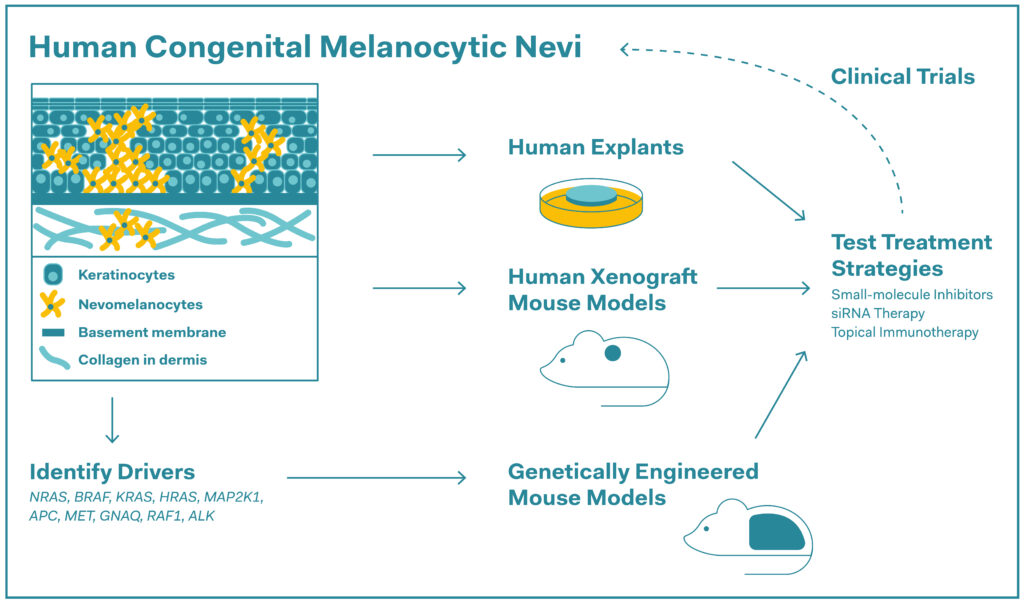
Preclinical research strategies to test repurposed therapies in congenital melanocytic nevi (CMN). Known drivers of CMN including genes with characterised mutations or fusions are listed and all discussed treatment strategies are included in the figure.
Source: Emerging Therapies for Congenital Melanocytic Nevi, 2025
Tests in mice fuel hopes
The next step was to test the potential therapy in animals – an essential step during which safety and efficacy are assessed in a living organism. The researchers injected the new medicine into mice with CMN. After just 48 hours, the effects were apparent. The mutated gene was being suppressed, and the abnormal skin changes started to recede.
Dr. Veronica Kinsler, Principal Group Leader and scientist at the Crick Institute and a member of the research project, is delighted, explaining that the disappearance of the moles and successful tests in mice represent milestones in CMN research. They offer hope for patients and their families. Although further testing is needed before the treatment can be trialled in humans, the studies in mice were nevertheless a necessary step in obtaining important data about the effect and risks of treatment.
Fresh hope for patients – and researchers
Ada’s parents also shared their views on the results. Knowing there could be a chance of their daughter’s CMN being reversed and a substantial reduction in her risk of developing skin cancer has blown their expectations out of the water. “It is mind-blowing to think that this treatment option could be available in only a matter of years.”
As well as being a leap forward in treatment, the project also highlights the strength of modern research. Thanks to a combination of laboratory cell-based models and animal testing, it is now possible to develop new treatments more specifically, faster and more safely. The study underscores the fact that although progress has been made on alternative methods, animal testing remains important in making the crucial final step to safe use in humans.
Sources:
- Researchers find potential of mole reversal therapy in rare condition. News an features; The Francis Crick Institute, 17 June 2024
- RNA Therapy for Oncogenic NRAS-Driven Nevi Induces Apoptosis. Journal of Investigative Dermatology, Volum 145, Issue 1, P122-134, January 2025.
- Emerging Therapies for Congenital Melanocytic Nevi: Journal of Experimental Pathology, 2025 ;6 (1).
Animal testing is often indispensable in biomedical research as a way of assessing the safety and efficacy of new treatments. It provides insights into the complex interactions that take place inside a living organism in a way that is not possible using alternative methods alone. Researchers are increasingly developing alternative methods such as organoids to further reduce the use of animals.